
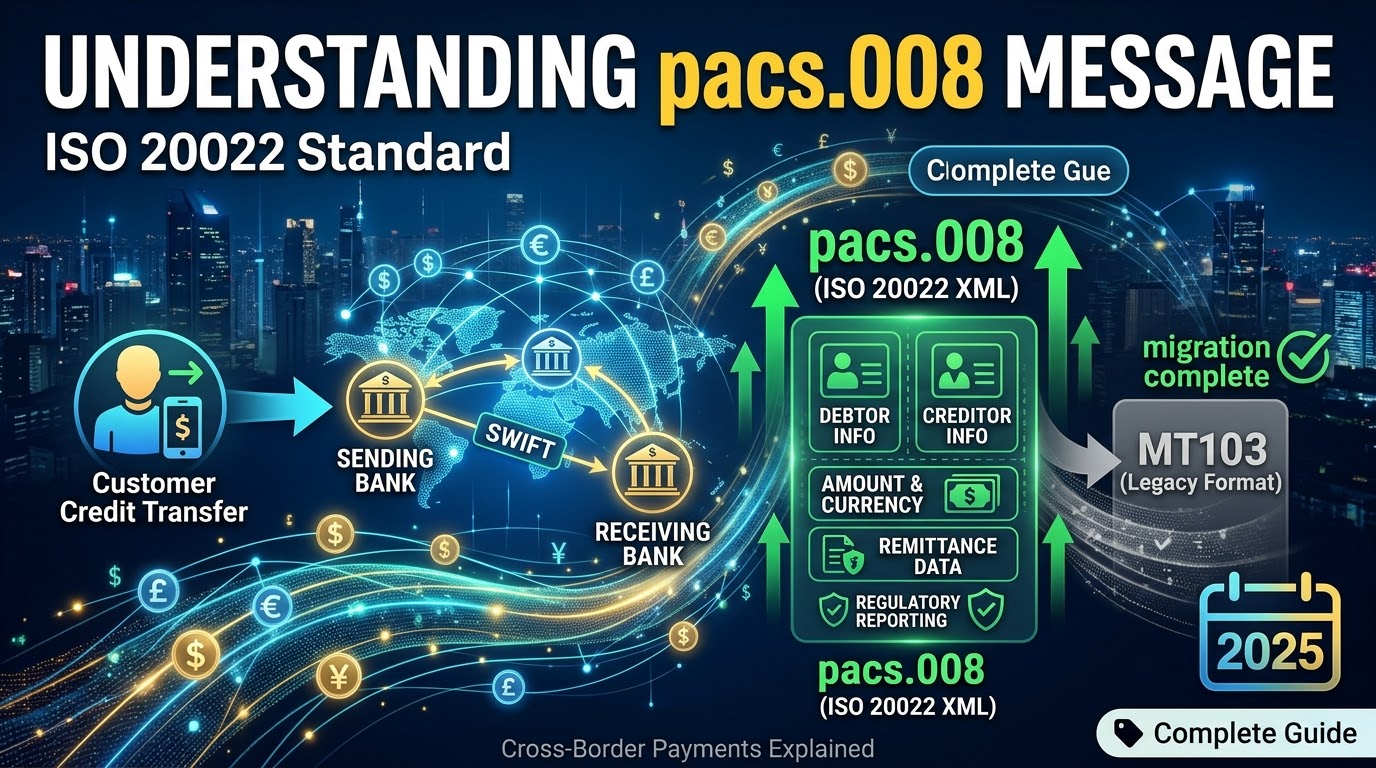
What Is a pacs.008 Message? A Complete Guide to the ISO 20022 Standard
When you send money internationally, banks do not simply move funds. They exchange structured electronic messages that contain the payment details. One of the most important message types used today is pacs.008, the ISO 20022 standard for customer credit transfers.
NEED THE SOFTWARE? CONTACT US!
This guide explains what a pacs.008 message is, how it differs from the older MT103 format, why banks migrated to it, and what information it carries.
What Is pacs.008?
pacs.008 (Payments Clearing and Settlement – FI to FI Customer Credit Transfer) is an ISO 20022 message used by financial institutions to instruct the transfer of money from one customer account to another.
It is the modern equivalent of the long-standing SWIFT MT103 message. Banks generate a pacs.008 automatically whenever a customer initiates an international wire or cross-border credit transfer. The message travels through the SWIFT network (or other payment infrastructures) from the sending bank, through any intermediary banks, to the receiving bank.
Unlike older fixed-length formats, pacs.008 is based on XML. This allows it to carry much richer and more structured data about the debtor, creditor, amounts, purpose of payment, and regulatory information.
ISO 20022 and the Shift Away from MT Messages
ISO 20022 is a global standard for financial messaging. It defines a common data dictionary and XML-based message formats that can be used across many payment systems, not only SWIFT.
SWIFT’s older MT (Message Type) series, including MT103 for customer payments, used a rigid, tag-based format with strict length limits. While reliable, these messages were limited in the amount and quality of information they could carry. Names were often truncated, addresses were free-text fields, and remittance data was restricted.
pacs.008 removes many of these constraints. Longer names, structured addresses, detailed remittance information, and better regulatory reporting fields all become possible. The richer data reduces the risk of payments being delayed or rejected because of incomplete information and improves straight-through processing rates.
SWIFT completed the migration of cross-border payment instructions to ISO 20022 (including the replacement of MT103 by pacs.008) on 22 November 2025. After that date, ISO 20022 became the required primary format for these payments on the SWIFT network. A temporary contingency conversion service remains available for remaining MT instructions, though it is chargeable from January 2026.
pacs.008 vs MT103: Key Differences
| Aspect | MT103 (Legacy) | pacs.008 (ISO 20022) |
|---|---|---|
| Format | Fixed tags with limited field lengths | Structured XML |
| Data capacity | Restricted (short names, limited text) | Much richer and longer fields |
| Address information | Mostly free-text lines | Structured (street, town, postcode, country, etc.) |
| Remittance information | Limited (typically up to 140 characters) | Unstructured or structured (more detailed) |
| Party identification | Basic free-text or limited options | Structured with support for LEI, multiple IDs |
| Tracking | UETR in message header | UETR native in the message body |
| Error reduction | Higher risk of truncation or missing data | Lower risk; better schema validation |
| Straight-through processing | Adequate | Improved thanks to richer, structured data |
In short, pacs.008 is designed to reduce exceptions, improve transparency, and support regulatory and compliance requirements more effectively than MT103.
How a pacs.008 Message Works
- A customer instructs their bank to send an international payment.
- The bank’s system automatically creates a pacs.008 message containing all required details.
- The message is sent over the SWIFT network (or another clearing system).
- Intermediary banks (if any) process and forward it.
- The beneficiary’s bank receives the message, credits the account, and may send confirmation or status messages (such as pacs.002) back.
From the customer’s perspective, the experience remains the same as a normal wire transfer. The message format itself is handled entirely in the background by the banks.
Key Elements of a pacs.008 Message
A typical pacs.008 consists of two main building blocks:
- Group Header (GrpHdr) – Message identification, creation date and time, number of transactions, and settlement information.
- Credit Transfer Transaction Information (CdtTrfTxInf) – The details of the individual payment (or payments). This contains:
- Payment identifiers (including End-to-End ID and UETR)
- Amount, currency, and interbank settlement date
- Charge bearer and any charge information
- Debtor (payer) name, address, and account
- Debtor agent (payer’s bank)
- Creditor (beneficiary) name, address, and account
- Creditor agent (beneficiary’s bank)
- Remittance information (purpose of payment, invoice references, etc.)
- Optional regulatory reporting and instruction fields
These structured fields allow banks and regulators to process and monitor payments more accurately than was possible with the older MT format.
Why the Change Matters
The move to pacs.008 and ISO 20022 brings several practical benefits:
- Higher straight-through processing rates and fewer manual interventions.
- Better data quality for sanctions screening and anti-money-laundering checks.
- Improved payment tracking and reconciliation for both banks and corporate customers.
- A foundation for future innovations in cross-border payments.
For most individuals sending money abroad, the change is invisible. For businesses that send large volumes of payments or need detailed remittance data, the richer information in pacs.008 can reduce delays and exceptions.
Summary
pacs.008 is the ISO 20022 message that banks now use to execute customer credit transfers across borders. It replaces the older MT103 format with a more flexible, data-rich XML structure. The migration on the SWIFT network for payment instructions was completed in November 2025, and the new standard is now the primary way financial institutions exchange payment instructions.
Understanding pacs.008 helps clarify what happens behind the scenes when money moves internationally, even if customers never see or request the message themselves.
Leave a Reply